
Trust nothing
Artificial intelligence and other technologies have advanced to the point that it's no longer possible to inherently trust anything you read, see, or hear.

It’s been possible to modify photographs since shortly after photography was invented. In the early days, it was clumsy and obvious (at least to modern-day viewers), but talented retouch and airbrush artists made the modifications hard to see. Some well-known Civil War photos were, in fact, composed from multiple images.
The Union of Soviet Socialist Republics was well known for photographic manipulation during the Stalinist regime. When people fell out of favor with Stalin, were accused of being traitors and executed; then they disappeared from photographs.
Nikolai Ivanovich Yezhov headed the Soviet Secret Police (NKVD) under Joseph Stalin from 1936 to 1938, during what was called the Great Purge. When Stalin lost faith in Yezhov, the former NKVD director was forced to confess to anti-Soviet activity and then executed. He was subsequently removed from the Great Soviet Encyclopedia and also from photographs.
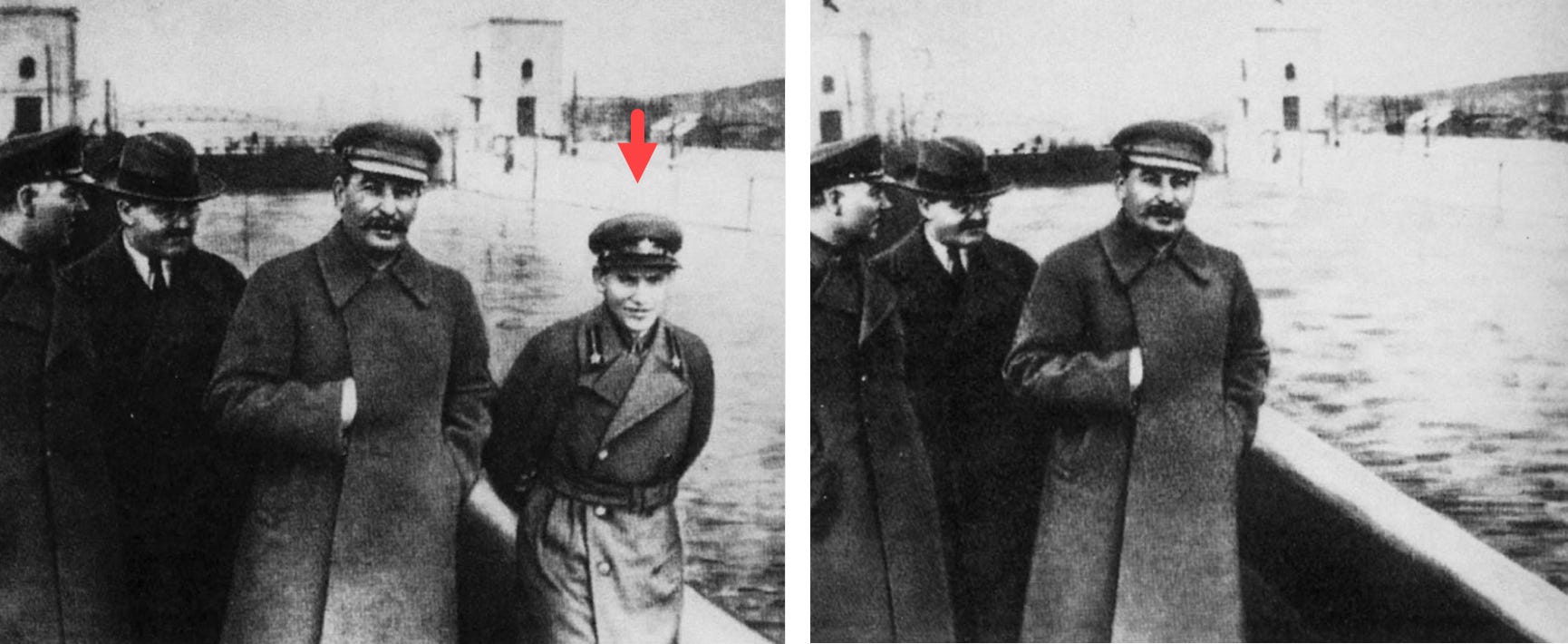
Wikipedia describes some of the better known incidents involving photo manipulation, but these kinds of events are now common.
Technology runs ahead
Here is a video of Holly Cat looking around and then walking toward the camera.
She never did this. Holly is skittish to say the least and would be unlikely to walk toward the camera. The tail is slightly wrong and, as she comes closer to the camera, the geometry of her face changes just a bit.
Google made that video from a single still picture.
Or, consider this short video of me.
I never did that and the hands, although surprisingly well done, show two rings despite the fact that I wear no rings. This is another video Google made from a single photograph.
Dangers are not trivial
Fabricated video of political candidates or officials can cause many problems such as modifying opinions based on false narratives, suppressing voter turnout, and even justifying unlawful actions.
Journalism is undermined when audiences are unable to trust visual evidence and legitimate reporting. Opinions and total fabrications can be equated with facts, allowing all sorts of nonsense to be considered true: The earth is flat, vaccines don’t work, or the nation’s capital is under siege by terrorist gangs when the earth is demonstrably not flat, vaccines are proven to work, and Washington DC’s crime rate is the lowest it’s been in decades.
Clearly we’re seeing evidence of this problem already.
The result is increasing polarization and cynicism. If everyone believes nothing is accurate and everyone thinks any report that fails to agree with their confirmation bias is false, compromise and consensus become impossible.
So maybe a better title for this episode would have been “Question everything”, or as Ronald Reagan put it, “Trust, but verify.”